 how-to
DNA Testing for Legal Paternity Disputes: 2026 Guide
Last Updated: October 23, 2026
Quick Summary
Legal paternity testing compares DNA from a child and an alleged father to determine whether a biological relationship exists, using results that can be admitted in court. The test settles biology only; courts then apply that finding to questions of custody, visitation, and child support.
- Chain of custody, not accuracy alone, decides whether a DNA result is admissible in court.
- A legal test requires photo ID, supervised collection, and a notarized report; a peace-of-mind test is not admissible.
- Confirm the court's approved laboratories and required accreditation before booking a legal test.
- An inclusion is reported as a probability of paternity, typically at or above 99.9999% when clear.
- If the alleged father has died, grandparentage testing using his parents' samples can sometimes establish a biological relationship.
Table of Contents
- What Legal Paternity DNA Testing Actually Proves
- How DNA Paternity Testing Works Step by Step
- Chain of Custody DNA Testing: Why It Decides Admissibility
- Legal vs At-Home Peace-of-Mind Tests
- How to File for DNA Testing for Paternity
- Legal Paternity Test Cost and Timeline
- When the Alleged Father Refuses, Is Absent, or Has Died
- Reading Your Results and What Happens Next
- Frequently Asked Questions
What Legal Paternity DNA Testing Actually Proves
Legal paternity testing is a laboratory analysis that compares DNA from a child and an alleged father to determine whether a biological relationship exists, using results that can be admitted in court. At DNA GENETICS LAB, LLC, we run these tests to answer one question with near certainty: is this man the child's biological father?
The test does not decide custody, visitation, or child support. It settles biology. Courts then apply that finding to the legal questions.
Genetic Markers, Probability of Paternity, and Exclusion
The lab examines short repeating sequences at specific locations in the DNA, often called genetic markers. A child inherits half of these markers from each parent. If the alleged father's markers match the child's inherited half at every location tested, he is not excluded.
Two outcomes matter:
- Exclusion: the man is not the biological father. This result is definitive.
- Inclusion: the man is the biological father, reported as a probability of paternity, typically at or above 99.9999% when the result is clear.
How DNA Paternity Testing Works Step by Step
The process follows a fixed path, and each step protects the result's legal standing.
- Confirm what your case requires: legal or peace-of-mind.
- Book a collection appointment through an accredited laboratory.
- Present government-issued photo ID at the collection site.
- Provide a cheek swab sample under supervised collection.
- The collector seals, labels, and signs the samples into the chain of custody.
- The laboratory extracts DNA and runs the genetic profile.
- Results are issued to the authorized parties.
Who Provides a Sample and How Collection Works
The child and the alleged father both provide samples. The mother's sample is often requested too, because it helps the lab rule out her genetic contribution and strengthens the statistical result.
Collection itself is simple. A trained collector rubs a soft swab against the inside of the cheek. No needles, no blood draw, no fasting. The sample dries, gets sealed in an envelope, and is logged with an identification number.
Chain of Custody DNA Testing: Why It Decides Admissibility
Chain of custody is the documented, unbroken record of who handled a DNA sample from collection to testing. Without it, a court has no way to know the sample was not swapped, contaminated, or mislabeled.
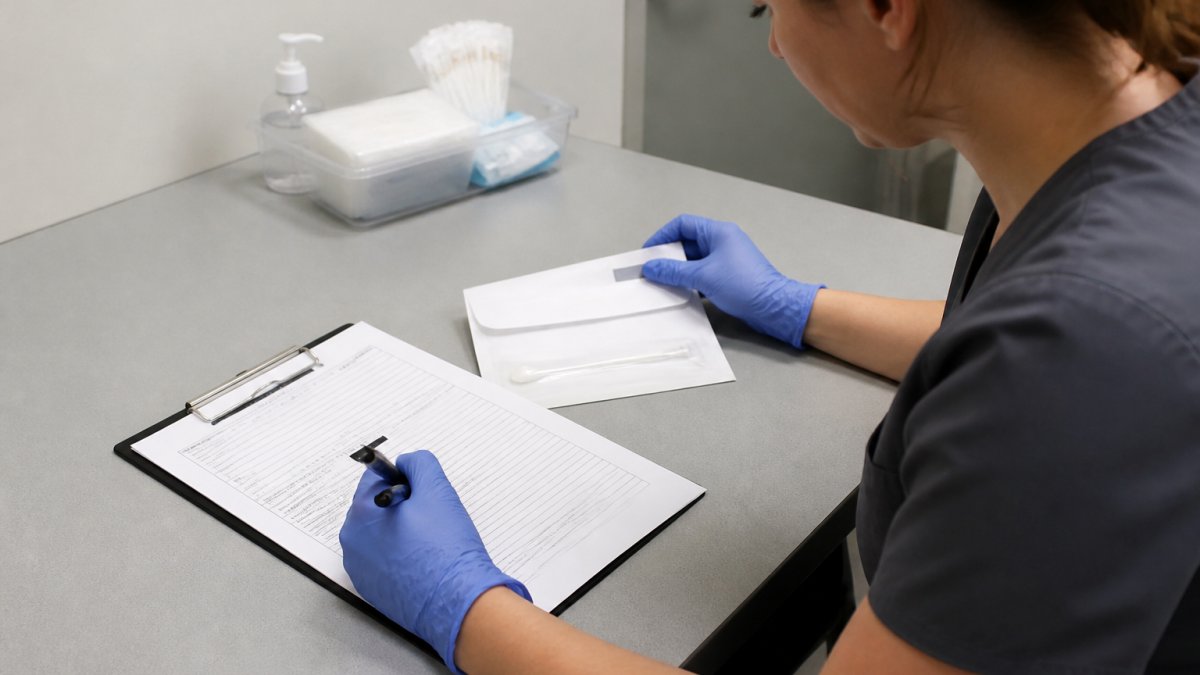
Every handoff gets a signature and a timestamp. The sample stays sealed until it reaches the testing laboratory. Identity verification, usually a photo ID check at collection, ties the person to the sample.
Legal vs At-Home Peace-of-Mind Tests
The two test types use the same science but produce very different documents. A legal test creates a court-admissible result. A peace-of-mind test gives you personal clarity and nothing more.
Feature | Legal Test | Peace-of-Mind Test |
|---|---|---|
Identity check | Photo ID required | None |
Sample collection | Supervised by a collector | Self-collected at home |
Chain of custody | Documented at every step | None |
Court use | Admissible | Not admissible |
Result format | Notarized legal report | Informational report |
Best for | Custody, support, immigration cases | Personal certainty |
If there is any chance the result will be used in a legal matter, order the legal test from the start. Re-testing later costs more than doing it right once.
How to File for DNA Testing for Paternity
Filing for a legal paternity test is a court procedure before it is a lab procedure. The sequence below is the practical order most family-law practitioners follow, but the specific forms, deadlines, and accepted laboratories are set by your state or country, so confirm local rules before you file anything.
Step 1: Identify the correct court and case type
Paternity disputes usually fall under family court, juvenile court, or a specific domestic-relations division, depending on your jurisdiction. If a child-support agency is already involved, the agency may have its own administrative process that runs alongside or instead of a court filing. The first practical question is whether you are opening a new case (a petition to establish parentage) or filing a motion inside an existing custody or support case.
Step 2: Prepare the petition or motion
A petition to establish parentage typically names the child, the mother, and the alleged father, and asks the court to determine biological parentage and then address custody, support, and related orders. If a case already exists, a motion for genetic testing asks the judge to order the parties to submit to a test at an accredited laboratory. Practitioners generally recommend that the motion specify:
- The laboratory or the accreditation standard the lab must meet (for example, AABB accreditation in the United States).
- Who is to be tested (child, alleged father, and often the mother).
- Who pays for the test and how the cost is allocated.
Vague motions that simply ask for "a DNA test" often get sent back for clarification, which adds weeks.
Step 3: Serve the other parties and attend the hearing
After filing, the other parties must be served according to local rules. Service methods vary: personal service, certified mail, or, when a party cannot be located, alternative service such as publication. At the hearing, the judge decides whether to order testing, which laboratory or standards apply, and who pays. Some jurisdictions order testing at the first hearing; others set a separate scheduling conference.
Step 4: Complete collection under the court's terms
Once the order is signed, collection must follow it exactly. That usually means a supervised cheek-swab collection at a facility approved by the court or the agency, with photo identification and a documented chain of custody. If the order names a specific laboratory, do not substitute another one, even if it is cheaper or faster.
Step 5: File the report and request further orders
The laboratory sends the result to the parties or to the court, depending on the order. The report then becomes the basis for orders on legal parentage, custody, visitation, child support, and birth-certificate changes. If the result is disputed, the next step is typically a request for the laboratory's accreditation records and analyst testimony.
Because these rules vary widely by jurisdiction, treat this sequence as a planning framework rather than legal advice. A local family-law attorney or the court's self-help center can tell you which forms apply to your case.
Legal Paternity Test Cost and Timeline
Pricing depends on the case type, the number of people tested, the collection location, and whether you need rush service.
Timelines follow the same pattern. Standard turnaround is measured in business days from the day the lab receives all samples, not from the day you book.
U.S. Centers for Disease Control and Prevention information on genetic testing is a useful starting point for understanding what accredited genetic testing involves.
When the Alleged Father Refuses, Is Absent, or Has Died
A missing or uncooperative alleged father does not automatically end a paternity dispute. Courts and laboratories have established alternatives, but each path has its own procedural requirements and evidentiary limits. The three scenarios below are handled differently, and the right approach depends on your jurisdiction.
If the alleged father refuses testing
A refusal is a legal event, not a dead end. If the court has already ordered testing and the alleged father does not comply, the judge may hold him in contempt, impose fines, or, in many jurisdictions, draw a negative inference, meaning the court may treat the refusal as evidence against him. The exact consequences depend on state or national law, so ask your attorney what your jurisdiction allows.
If the alleged father cannot be located
When a party cannot be found after reasonable efforts, courts may allow alternative service, such as publication in a newspaper of record or service through a relative or last known employer. The court generally requires proof of the search effort, often an affidavit describing the attempts made. If the alleged father is outside the country, service may need to follow international procedures, which can add significant time.
If the alleged father has died
Direct testing is no longer possible, but indirect testing can sometimes establish a biological relationship. The most common approach is grandparentage testing, using samples from the alleged father's parents to determine whether the child is biologically related to them. Other options include testing siblings of the alleged father or, in some cases, using stored samples or medical records if they exist and can be authenticated.
Practical preparation for all three scenarios
- Document every attempt to contact or locate the alleged father, including dates and methods.
- Ask the court what proof of search effort it requires before alternative service.
- Confirm with the laboratory which relatives can provide useful samples and what consent is needed.
These scenarios are exactly where a jurisdiction-aware plan matters most. The procedures differ enough that a local attorney or the court's self-help resources should be consulted before you file or collect anything.
Reading Your Results and What Happens Next
The report states either an exclusion or an inclusion with a probability of paternity. An inclusion at or above 99.9999% is about as close to certainty as biology allows. An exclusion is absolute.
What happens next depends on your case:
- File the notarized report with the court.
- The court issues orders on custody, support, or the birth certificate.
- If the result is disputed, expect a request for the laboratory's accreditation records and analyst testimony.
At DNA GENETICS LAB, LLC, we provide expert consultation for depositions and testimony, so the people who ran your test can explain it. Our results meet or exceed a 99.9999% probability level, and we use the 13 CODIS loci established by the FBI for forensic identification.
Frequently Asked Questions
What is the difference between a legal and a peace-of-mind DNA test?
A legal paternity test follows a documented chain of custody: samples are collected by an authorized collector, identity is verified, and paperwork tracks every hand the sample passes through. A peace-of-mind test lets you swab at home, but the result is for personal clarity only. Courts generally will not accept an at-home kit because there is no proof of whose sample was tested. If the result may be used in a paternity dispute, custody hearing, or birth certificate change, request a legal test from an accredited laboratory from the start.
Can you do a DNA test without the alleged father's consent?
A laboratory cannot force anyone to give a sample, and taking a sample without consent is not an option. If the alleged father refuses, the usual route is to ask the family court to order testing. A documented refusal can also be raised in court proceedings, where a judge may weigh it. When the person cannot be located or has died, laboratories can sometimes test close relatives or stored samples, but this depends on the case and should be discussed with the lab and your attorney before you file.
How long does a legal paternity test take, and what affects the cost?
Timelines vary by laboratory, collection site, and case complexity. Standard legal testing typically runs from sample receipt at the lab to a signed report, and rush options shorten that window. Cost depends on the number of people tested, whether collection is at a site or mobile, and any rush service. DNA Genetics Lab, LLC does not publish fixed prices here, so request a quote for your specific case. Build extra time into any court deadline rather than assuming the fastest turnaround.
Will a DNA test result hold up in court?
A result is far more likely to be admitted when it comes from an accredited laboratory, uses a documented chain of custody, and includes verified sample identification. DNA Genetics Lab, LLC is certified to produce DNA fingerprints for the National DNA Indexing System and reports results at or above a 99.9999% probability level. Admissibility is ultimately decided by the court under its own rules, so confirm the specific requirements with your attorney and the testing laboratory before collection begins.
A paternity dispute moves fast once it reaches court, and a flawed sample or an unaccredited lab can undo months of work. DNA GENETICS LAB, LLC handles legal paternity testing with documented chain of custody, results at or above a 99.9999% probability level, rush options for tight hearing dates, and direct access to the staff who ran your test. Book an appointment with DNA GENETICS LAB, LLC and get evidence that stands up when it counts.
